The Unbridled Wrath of a Fallen Titan
On the quiet violence of unused brilliance
What happens when extraordinary minds become prisoners of their own hesitation, while lesser talents boldly seize the opportunities they were too afraid to pursue? A reflection on hidden brilliance, the quiet violence of complacency, and the devastating cost of a life never fully lived.
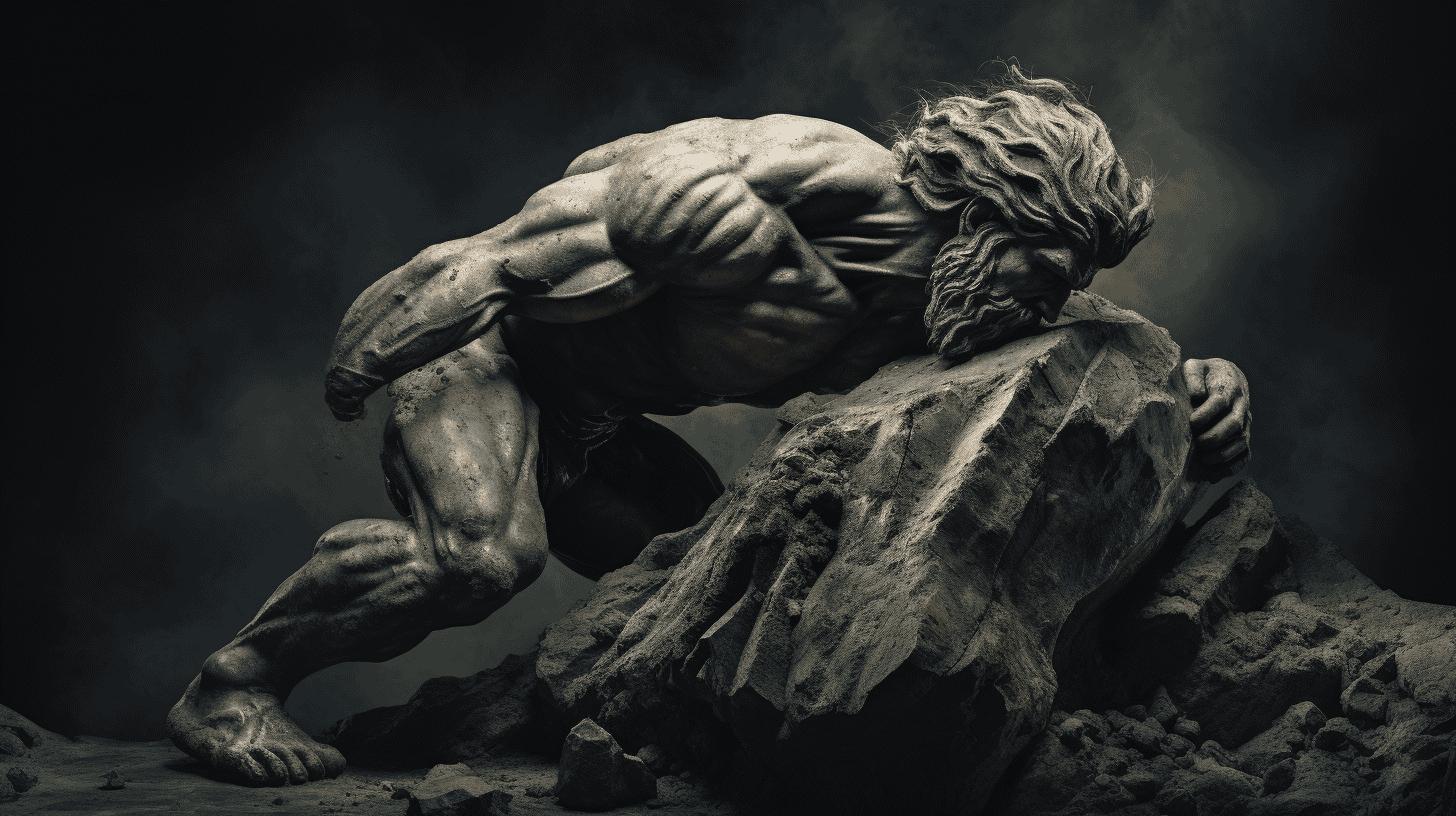
The Unbridled Wrath of a Fallen Titan | DAVIEY
There is a particular kind of humiliation in watching someone less capable do the very thing you've spent years convincing yourself you're not ready to do.
Not because they stole your idea. Not because they cheated. Sometimes they simply got up and did it. Badly, perhaps. Loudly. With a confidence that ought to have been subjected to at least one committee hearing. But they did it.
And there you are, a genius in the waiting room of your own life, still perfecting the introduction.
Fateci caso. Pay attention.
We live in a strange time. The mediocre have discovered the extraordinary commercial value of audacity, while some of the most capable people you'll ever meet have made entire lifestyles out of hesitation.
The man with half the knowledge announces himself an authority. The one who knows how much he doesn't know is still checking his references.
One submits the proposal. The other rewrites it for the seventeenth time.
One builds a terrible version of the thing and learns in public. The other builds a magnificent version in his head, where it enjoys the considerable advantage of never being rejected.
And somehow we are surprised by who gets the opportunity.
I don't say this because the world is a perfect meritocracy. Far from it. Luck, access, money, connections, inherited advantage, and plain old injustice have always helped decide who gets heard. Boldness does not cancel those realities.
But even within the small territory that remains under our control, some of us have become remarkably skilled at surrendering ground.
We call it being realistic.
We call it maturity.
We call it waiting for the right moment.
Sometimes it is all three. Sometimes it is fear wearing a respectable shirt.
I have been thinking about the fallen Titan.
Not the one brought down in some spectacular war against the gods. That would at least make for a decent story.
I mean the other one.
The giant who gradually learned to crouch, then to kneel, then to convince himself that the ceiling had always been this low.
Nobody had to chain him. Eventually he began carrying the chains himself, carefully polished, explaining to younger giants how important it was to be practical.
There is no single moment of defeat in this story. That's what makes it cruel.
A little rejection here. A humiliating attempt there. A responsibility you cannot abandon. Rent. Children. Family expectations. A project that almost worked. People who made your ambition sound childish. People who loved you, perhaps, but only the smaller version of you they knew how to accommodate.
The Titan does not fall all at once. He is reduced by instalments.
— My Frustrated Potential
And because most of these concessions have reasonable explanations, he hardly notices what they add up to.
I find that frightening.
Probably because I recognise it.
There is a version of me that has spent a suspicious amount of time preparing to become himself.
Learning another skill. Refining another plan. Acquiring another tool. Telling himself that when the conditions improve, when the money comes, when the work settles, when life stops happening quite so aggressively, then he will finally begin.
The trouble is, life has never shown much interest in clearing its schedule for my grand arrival.
And I cannot help wondering how many extraordinary lives have been postponed into ordinary ones this way.
Not destroyed. Not even abandoned in any dramatic sense.
Just delayed until the desire became embarrassing, then impractical, then something one mentions over drinks as evidence of a person one used to be.
"I could have."
Four of the most expensive words in any language.
There is an old image of a candle hidden under a bowl. It is usually used to remind us not to conceal our light.
But I keep returning to the physics of it.
A flame does not merely become invisible beneath a bowl.
Given time, it runs out of air.
That is what makes the image so disturbing.
The hiding doesn't just deprive the world of the light. It kills the light itself.
— My Potential's Cousin, Brilliance
We like to imagine that our gifts remain intact while we wait. That talent is some precious object we can lock away and retrieve whenever we feel sufficiently safe.
But courage atrophies.
Curiosity can be trained into silence.
A voice unused for years may still exist, but it has forgotten the sensation of being heard.
Even fire requires conditions in which to burn.
And while we are busy safeguarding our potential, other people are spending theirs.
Some of them are truly remarkable. Some are spectacularly average. Some are wrong about nearly everything and inexplicably confident about the remainder.
Yet they are moving, and movement creates evidence. Evidence attracts people. People create opportunities. Opportunities create experience. Experience, occasionally, produces competence.
It is a rather annoying system, especially for those of us who hoped the universe would recognise quality before requiring us to demonstrate it.
But the world cannot respond to a masterpiece it has never encountered.
I should be careful here.
This is not an argument for arrogance. The world has enough men mistaking volume for substance, cruelty for strength, and attention for achievement.
I am not asking the thoughtful to become thoughtless.
Nor am I suggesting that every quiet person is secretly a genius, or that every successful loudmouth is a fraud.
That would be too convenient. It would allow us to preserve our vanity without examining our behaviour.
No.
The uncomfortable possibility is that the person we dismiss as mediocre may understand something vital that we don't.
They understand that an imperfect action in the real world can change a life, while a perfect intention, privately admired, changes very little.
Perhaps the real tragedy is not that lesser men have become bold.
Perhaps it is that capable men have confused self-doubt with depth.
That we have turned discernment into paralysis and called our reluctance humility.
That we have learned to speak so intelligently about why a thing may fail that we no longer have to endure the embarrassment of trying.
And there is something seductive about being the misunderstood Titan.
If no one ever witnesses your attempt, no one can measure its result.
Your greatness remains safely hypothetical.
You can always tell yourself you would have done better.
I know.
Very convenient arrangement.
So what becomes of his wrath?
Because I do believe there is wrath in such a creature.
Not necessarily the theatrical kind.
Sometimes it looks like irritability, envy, exhaustion, contempt for people who dare to try.
Sometimes it is the bitterness of watching a world move forward without consulting the plans you never submitted.
And sometimes, if one is honest enough to look underneath it, the anger is not really directed at the people succeeding.
It is directed at the self who kept retreating.
That is a difficult anger to sit with.
It offers no convenient villain.
It asks what was truly taken from you, and what you handed over without a fight.
It demands that you distinguish circumstances you could not control from decisions you were simply afraid to make.
I do not think the answer is to unleash that wrath on the world.
A fallen Titan swinging at everyone who reminds him of his fall is not a hero. He is just another wounded man making his wound everybody else's problem.
The more interesting possibility is to turn that energy into a refusal.
A refusal to remain theoretical.
To stop introducing yourself through the things you intend to do.
To make the song, write the essay, submit the idea, build the ugly first version, take the stage, survive the criticism, and return the following day with something better.
To let the work be visible enough to be judged.
To risk discovering that you are not yet as good as you thought, because at least then you have something real to improve.
Perhaps that is the unbridled wrath of a fallen Titan:
About this work
A capable person watches somebody less prepared attempt the thing he has spent years preparing to attempt. The irritation becomes a harder question: how often does discernment conceal a fear of being seen trying?
The fallen Titan is reduced by instalments rather than defeated in one grand event. Responsibilities, rejections, practical compromises and the wish to protect an imagined greatness all contribute. The essay acknowledges real inequality and obligations while inspecting the smaller territory where a person still has agency. Its candle-under-a-bowl image turns concealment into a problem of survival: a gift cannot be preserved indefinitely by withholding the air it needs.
The anger in the title is redirected toward an end to cooperation with one's own diminishment. Making the song, writing the essay, submitting the idea and surviving judgment become ways to exchange hypothetical ability for evidence. The piece connects the early poems about conformity and definitions to the urgency of LET’S GO and the broader creative philosophy of THIS IS DAVIEY.