A Particularly Nice Form of Disdain
On being explained to yourself by someone who barely knows you
She said she was a nice person. Then came the little comments about my mother, my absent father, and the life she thought I ought to live. Somewhere between her diagnosis and my defence, I began to wonder whether we had both mistaken assumptions for understanding.
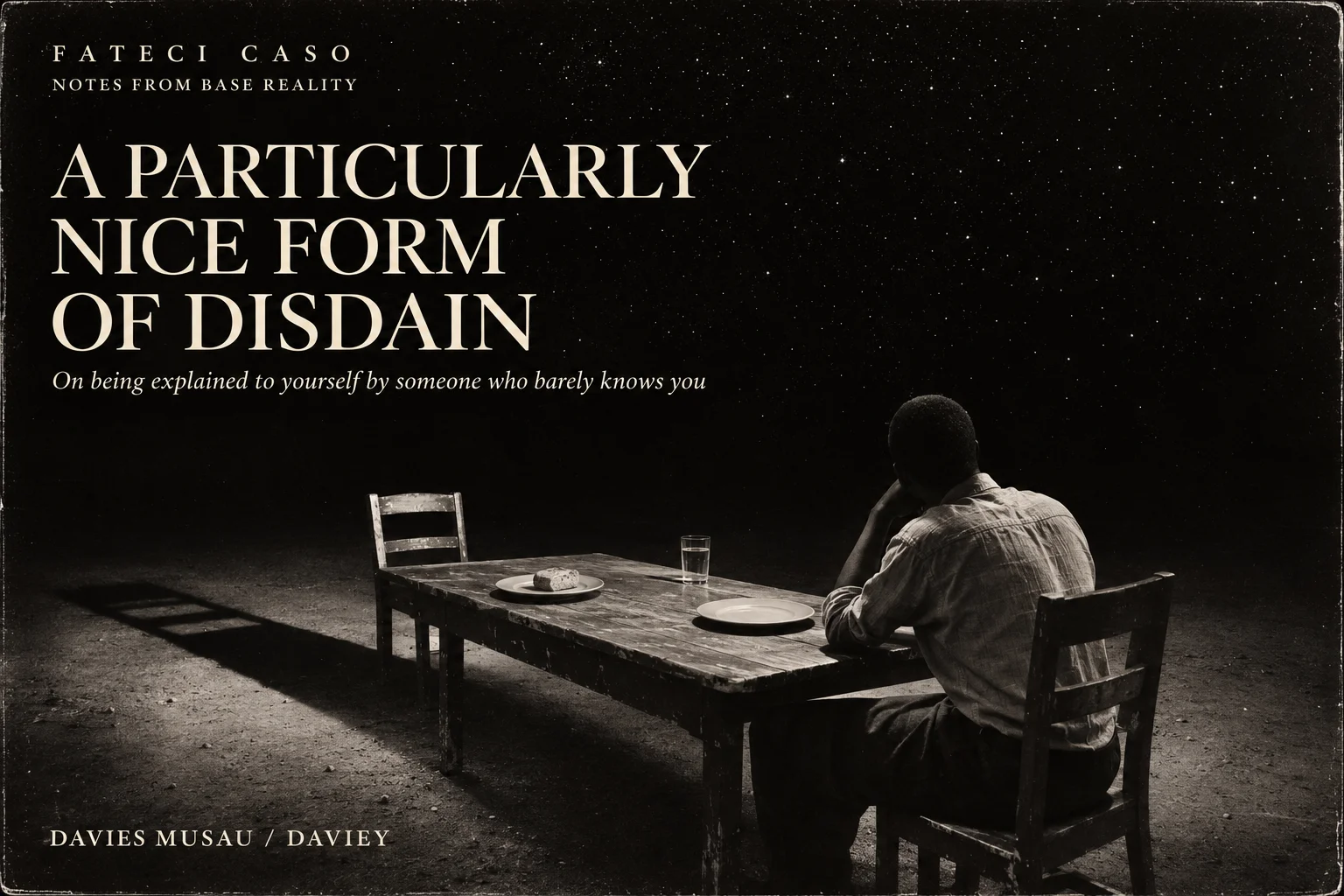
You see, the interesting thing about someone telling you they're a nice person is that, at some point, you have to stop listening to the description and start paying attention to the demonstration.
She said she was nice. I had no particular reason to dispute it. Then came the little comments. Something about my mother. Something about the father who was never really there. Nothing quite dramatic enough to build a court case around. Just those carefully placed remarks that seem harmless if you isolate them, but begin to reveal a pattern when you put them together.
And as time went by, I began to notice a certain disdain. Not necessarily for me, I think, but for the boy she had decided I was.
It's a peculiar experience, watching someone form an opinion of you while you're still in the room. You can almost see the machinery working. A little information here, a childhood circumstance there, one unusual habit, and suddenly the whole man has been explained.
Case closed. Next patient.
Apparently, it would have been nice if I could concentrate on the important things. Our next meal, for instance. The immediate, tangible, necessary things. Not the meaning of life, or whatever philosophical nonsense she believed I disappeared into whenever reality became inconvenient.
And to be fair, she wasn't entirely wrong.
I've escaped into thought before. Plenty of times. When existence becomes painful enough, the mind starts looking for exits, and philosophy can be a very beautiful emergency door. An entire universe of questions to keep you occupied while the one directly in front of you is falling apart.
I know. Very convenient arrangement.
But there's another truth in there, one I don't think she was particularly interested in discovering.
Much of my life has been spent attempting to satisfy an idea of me that belonged to somebody else. Be sensible. Be practical. Be this kind of man. Want these things. Chase these rewards. Measure your worth against these standards. And if something inside you protests, give it a respectable name like immaturity and carry on.
It's an exhausting way to live. A slow death, really. Not the dramatic kind with a final speech and a beautiful soundtrack. The quiet sort, where you get a little better at abandoning yourself every day until people congratulate you on how well you've adjusted.
Somewhere in there is a fallen Titan, still breathing, being advised to stop asking questions and find something useful to do.
Now, don't misunderstand me. The next meal matters. Rent matters. Responsibility matters. A hungry man cannot dine on existentialism, regardless of how beautifully he articulates it. I've learned that the hard way, and I'm still learning.
But must the price of being responsible be the death of curiosity?
Is survival the whole point of being alive? Are we supposed to eat, work, sleep, repeat, and politely refrain from wondering what any of it means? Surely we can put food on the table and still ask why we are seated at it in the first place.
I don't need a partner who agrees with every strange thought that wanders through my head. God knows that would be an exhausting full-time position. But there's a difference between challenging someone's thinking and treating their inner life as a defect that needs correcting.
There's also a difference between asking about somebody's wounds and making those wounds part of your assessment of their worth.
My mother is not a cheap argument. My father's absence is not a character reference. Neither one provides a stranger with a complete psychological map of the person I became.
And yet, by the time she had finished explaining who I was, what I was, and who I could become if only I'd rearrange my priorities to resemble hers, I had made up my mind about her too.
Which is where this becomes a little embarrassing.
Because I had been sitting there resenting her assumptions while constructing a few of my own. She thought she understood me; I thought I understood her. Two people, each convinced the other had failed to pay attention, having read approximately three pages of a book neither had written.
An assumptive assumption of assumptions.
Yes, that's a terrible sentence. It is also, unfortunately, quite accurate.
Maybe she was trying, clumsily, to ask whether I could build a life with someone. A reasonable question. Maybe I heard contempt where she intended concern. Or maybe the contempt was real, and I recognised it because I've spent so much of my life trying not to become the person other people keep prescribing.
I don't know which explanation gets to claim the whole truth. That's the trouble with being inside an experience: your feelings are evidence that something happened to you, but not always a complete account of what happened between you.
What I do know is that we never got far enough to call this a relationship. It was a possibility. A door slightly open. The kind of almost-something that ends before there's even a proper story to tell, yet leaves you with enough material to interrogate your entire existence.
Very economical, heartbreak-wise.
Perhaps that was for the best.
She seemed to want me brought down to earth. I wanted someone who wouldn't mistake my looking at the stars for an inability to see the ground.
We could have done both, I think. Made dinner. Paid bills. Asked ridiculous questions about consciousness over a plate of food. Built something real without making one person's imagination the enemy of the other's need for stability.
But you cannot build that with someone if the conversation begins with a verdict.
And I suppose I cannot build it either if every uncomfortable question sounds, to me, like another attempt to put a lid over my flame.
There's work for both people in that observation. Even if there will be no both people to do it.
So perhaps the lesson isn't that nice people are secretly cruel, or that practical people lack imagination, or that misunderstood men are invariably brilliant. All three would make excellent excuses. None would require me to examine myself.
Perhaps the lesson is smaller. More difficult.
Before you decide who someone is, find out.
And if you cannot love the person you discover, at least have the decency not to call your disappointment an objective diagnosis.
Fateci caso. Pay attention.
About this work
An almost-relationship becomes the setting for a discussion of kindness, contempt and the ease with which a person can mistake a few biographical details for a complete understanding of somebody else. The narrator hears concern about responsibility as a verdict on his inner life. Remarks about family and priorities begin to feel like an attempt to prescribe a smaller version of him.
The essay refuses the comfort of a simple villain. He notices that while resenting her assumptions he has been building a theory of her too. Financial responsibility remains real; imagination and curiosity remain necessary. What is being negotiated is whether a shared life can make room for both without treating one person's aspirations as a defect.
Its movement from indignation to reciprocal self-examination makes the work a companion to Fallen Titan rather than a repetition of it. The concern is dignity inside an intimate encounter: before explaining a person to himself, allow the possibility that you have not met enough of him yet.